
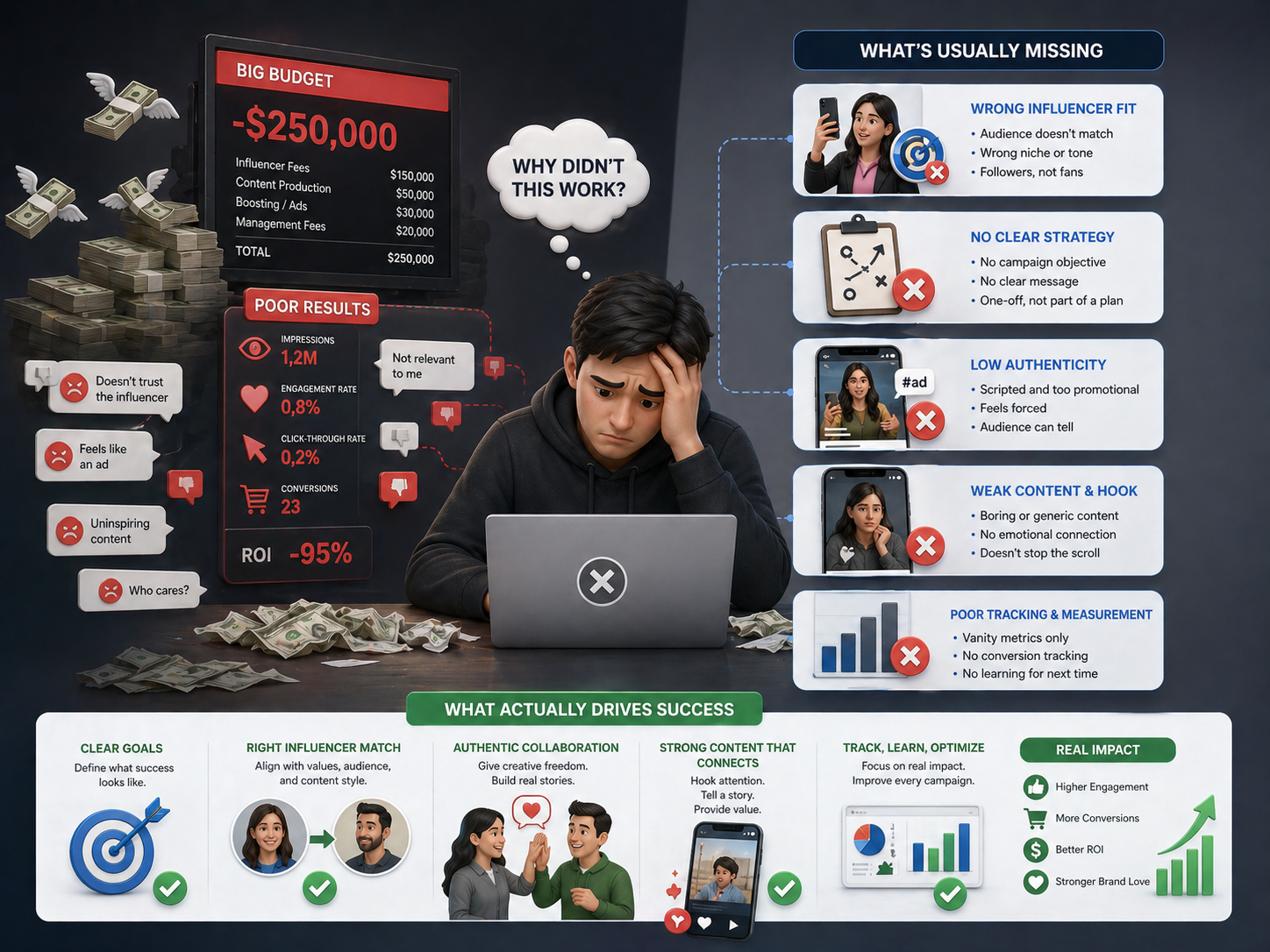
Influencer marketing has become one of the most widely used strategies in today’s digital landscape. Brands are investing larger budgets than ever before, hoping to gain instant visibility, engagement, and conversions. However, from what I have observed across multiple campaigns, the size of the budget does not guarantee success. In fact, many high budget influencer campaigns fail to deliver meaningful results.
The real issue is not how much is spent, but how strategically it is executed. Without the right approach, even the most expensive campaigns can fall short of expectations.
The Illusion of Big Budgets
One of the biggest misconceptions in influencer marketing is the belief that higher spending automatically leads to better results. While budget can amplify reach, it does not ensure effectiveness.
Many campaigns allocate large portions of their budget to high profile influencers without evaluating whether those influencers are actually relevant.
Some common issues include:
- Prioritizing reach over engagement
- Paying for visibility without a clear conversion plan
- Focusing on vanity metrics such as likes and impressions
- Ignoring audience quality and behavior
From my perspective, a budget should act as a tool to scale a strong strategy, not replace it. Without a clear foundation, increasing spend only magnifies inefficiencies.
Choosing the Wrong Influencers
Influencer selection is one of the most critical factors in campaign success. Yet, many brands still choose influencers based on surface level metrics.
Follower count is often misleading. What truly matters is how engaged and relevant the audience is.
Key mistakes in influencer selection include:
- Choosing influencers with high followers but low engagement
- Ignoring audience demographics and interests
- Overlooking niche creators with stronger community trust
- Selecting influencers whose content style does not align with the brand
An influencer with a smaller but highly targeted audience often delivers better results than one with a broad but disengaged following.
Lack of Clear Campaign Objectives
Another major reason campaigns fail is the absence of clear goals. Without defined objectives, it becomes difficult to measure success or optimize performance.
Campaigns should be built around specific outcomes such as:
- Increasing brand awareness
- Driving website traffic
- Generating leads
- Boosting sales conversions
Each objective requires a different strategy, content approach, and measurement framework.
When objectives are unclear, campaigns often become directionless, resulting in wasted budget and missed opportunities.
Weak Creative Direction
Creative execution is where many campaigns lose their impact. Influencer marketing relies heavily on authenticity, yet brands often try to control messaging too tightly.
Content that feels overly scripted or promotional tends to perform poorly. Audiences are quick to recognize when something feels unnatural.
Common creative mistakes include:
- Forcing rigid scripts that limit influencer creativity
- Ignoring platform specific content styles
- Over emphasizing product features instead of storytelling
- Lack of emotional connection in content
Strong campaigns allow influencers to communicate in their own voice while maintaining alignment with brand values.
Read also : Build Successful Campaigns with Influencers
Poor Audience Targeting
Even with the right influencer, campaigns can fail if they are not targeting the right audience. Understanding who the content is meant for is essential.
Broad targeting may increase impressions, but it often reduces relevance and engagement.
Effective targeting involves:
- Identifying specific audience segments
- Understanding user behavior and preferences
- Leveraging niche communities
- Aligning content with audience interests
From what I have seen, campaigns that focus on precise targeting consistently outperform those that aim for mass reach.
Lack of Integration with Overall Strategy
Influencer campaigns are often treated as standalone efforts. This limits their impact and reduces their contribution to overall business goals.
A successful campaign should be integrated into a broader marketing strategy. This includes alignment with:
- Social media content strategy
- Website landing pages
- Email marketing funnels
- Paid advertising campaigns
Without this integration, influencer campaigns may generate attention but fail to convert it into meaningful results.
Ignoring Data and Performance Metrics
Data is one of the most valuable tools in improving campaign performance. However, many brands fail to track and analyze their campaigns effectively.
Without data, it is difficult to understand what works and what needs improvement.
Important metrics to monitor include:
- Engagement rate
- Click through rate
- Conversion rate
- Cost per acquisition
Continuous optimization based on these insights is essential. Campaigns should evolve over time, not remain static.
Short Term Thinking
Many influencer campaigns are designed as one time activities. This approach often leads to temporary spikes in engagement but fails to create lasting impact.
Building long term relationships with influencers can significantly improve results. Consistency helps reinforce brand presence and trust.
Long term strategies include:
- Ongoing collaborations with selected influencers
- Building ambassador programs
- Creating recurring content series
- Strengthening audience familiarity over time
From my perspective, influencer marketing works best when it is treated as a continuous effort rather than a one time campaign.
The Importance of Authenticity
Authenticity is the foundation of influencer marketing. Audiences follow influencers because they trust their opinions and perspectives.
When content feels forced or overly controlled, that trust is lost.
Brands should focus on:
- Allowing influencers creative freedom
- Encouraging genuine storytelling
- Avoiding overly promotional messaging
- Building real connections with audiences
Authenticity cannot be manufactured. It must be built through collaboration and trust.
Building Sustainable Campaigns
Successful influencer marketing is not about quick wins. It is about building a system that delivers consistent results over time.
This requires:
- Strategic planning
- Careful influencer selection
- Strong creative direction
- Continuous optimization
From what I have observed, campaigns that prioritize long term value tend to outperform those focused on immediate results.
Conclusion
Influencer campaigns fail not because of limited budgets, but because of weak strategy and execution. Spending more money does not fix fundamental issues.
The key to success lies in understanding the audience, choosing the right influencers, and creating authentic content that resonates.
In the end, influencer marketing is not about how much you spend, but how effectively you connect. When strategy, creativity, and authenticity come together, even modest campaigns can deliver powerful results.